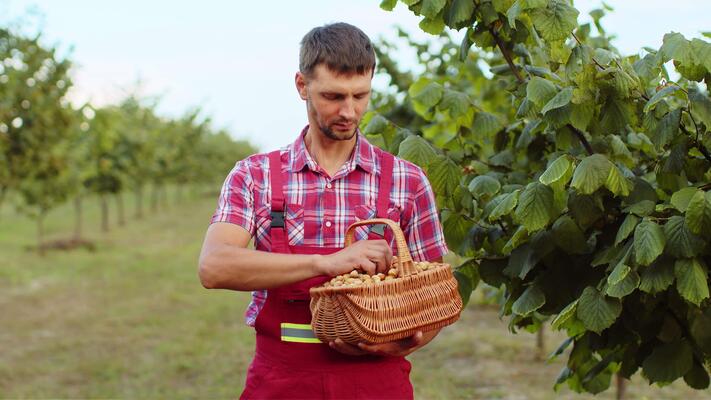
The 2025 hazelnut harvest season brings both challenges and opportunities for participants in the global market. Climate anomalies, shifting consumer preferences, and new trade conditions are shaping the industry landscape for years to come.
Global Production Forecast
According to international analysts' estimates, global hazelnut production in the 2024/2025 season will reach approximately 550-580 thousand tons in-shell. The leading producers remain Turkey, Italy, Azerbaijan, and the United States. At the same time, there is a growing trend toward an increased share of Azerbaijani hazelnuts in the global market, driven by plantation expansion and higher yields.
Climate Factors
This season has been marked by a number of climatic features that have affected yields across different regions. A mild winter and sufficient spring rainfall created favorable conditions for flowering and fruit set in Azerbaijan. However, some regions of Turkey and Italy faced dry spells, which slightly reduced projected volumes.
Factors Affecting the 2025 Harvest:
- Temperature conditions — an unusually warm winter accelerated the growing cycle
- Rainfall — sufficient moisture ensured good fruit development
- Absence of frost — spring frosts did not damage the flowering orchards
- Technological factor — modern agricultural techniques boosted yields
The Situation in Azerbaijan
Azerbaijan is showing positive momentum in hazelnut production. According to preliminary data, the 2024/2025 harvest will exceed 18 thousand tons in-shell, up 10-12% from the previous season. This growth is driven by newly commissioned plantations as well as favorable weather conditions in the main growing regions.
The quality of Azerbaijani hazelnuts is also improving thanks to investments in processing capacity and quality control systems. Modern sorting and grading lines make it possible to deliver products that meet the strictest requirements of international buyers.
Price Trends
The global hazelnut market is experiencing moderate price growth driven by several factors. On one hand, steady demand from the confectionery industry keeps prices at a high level. On the other hand, rising production costs — for fertilizers, energy, and labor — are also affecting the final cost of the product.
This creates favorable conditions for Azerbaijani exporters. A competitive production cost combined with high quality allows them to offer products at attractive prices while maintaining a solid profit margin.
Outlook for the Coming Years
Experts predict further growth in global demand for hazelnuts, driven by the trend toward healthy eating and increased nut consumption. China, Southeast Asia, and the Middle East remain particularly promising markets, where per-capita nut consumption is still below the European level.
Azerbaijan has every chance to strengthen its position on the international market. The industry's development strategy calls for expanding plantations, modernizing processing capacity, and developing export infrastructure. Forecasts suggest that by 2028 production volume could reach 25-30 thousand tons annually.